If I am playing Beta v0.111.0, the first things I relearn are Expect a Fight and Hyperbeam. They are not small number tweaks; both cards now ask a different question when they appear in a reward.
After that, I check the cards whose upgrade priority changed, especially Mirage, Null, and Synchronize, then I pay more attention to damage breakpoints at A8 and A9.
If I am still on the default Main v0.107.1 branch, none of that means I should replace my current Main values with the Beta numbers. I treat the two branches separately.
Short version: v0.111.0 does not make Slay the Spire 2 feel like a different game. It does invalidate several old shortcuts: Hyperbeam is much easier to justify, Expect a Fight has a completely new role, some upgrades matter more, and several high-Ascension fights punish old lethal calculations.
Expect a Fight Is a Different Card Now
The Ironclad change I would relearn first is Expect a Fight.
Previously, I judged it around Energy generation. In v0.111.0 it becomes a 3-cost Skill that gives 15(16) Block plus 5(8) additional Block for each Strength.
That is not the same card with better numbers. Its entire job changed.
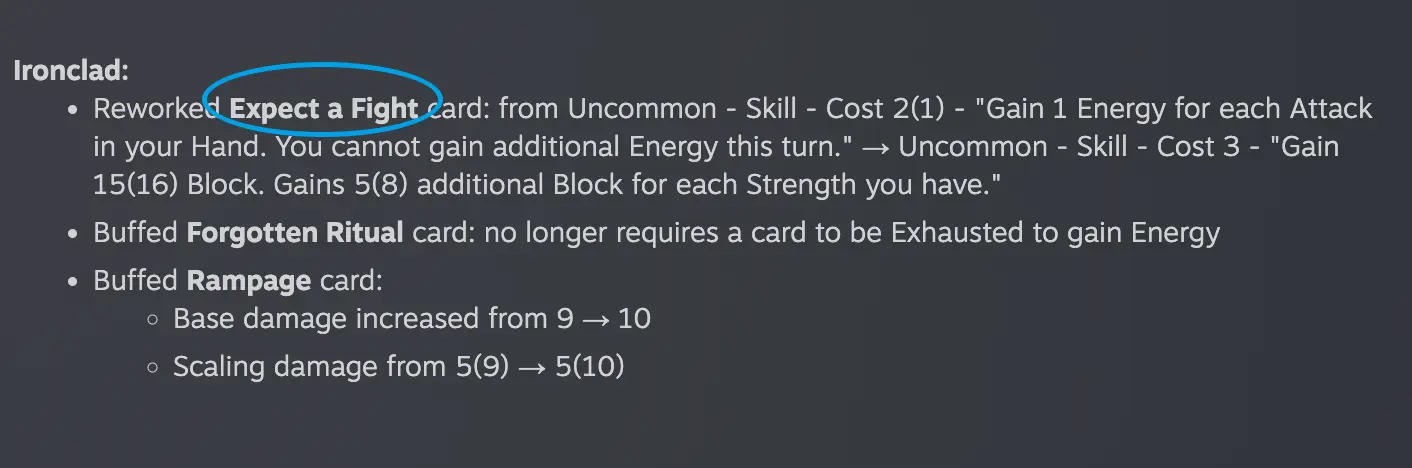
Expect a Fight is now expensive Strength-scaling defense. The question is no longer how much Energy it can generate, but whether the rest of my deck can support spending 3 Energy on one defensive turn.
The obvious upside is Strength. If I already have a reliable Strength source, the Block ceiling rises very quickly.
The awkward part is the 3 Energy cost.
A card can block for a huge number and still be difficult to play if the same turn also needs a Power, setup card, or expensive attack. When I see Expect a Fight now, I check two things before getting excited:
- Do I already have Strength, or a reliable way to start gaining it?
- Can my deck afford to spend most of a turn on one defensive card?
If both answers are yes, the rework gives Ironclad a very real defensive payoff.
If the deck still has base Energy and no Strength engine, the printed Block ceiling is much less important than how often I can actually play the card without ruining the turn.
Forgotten Ritual also becomes easier to use because it no longer requires a card to actually be Exhausted before granting Energy. That removes one of the awkward conditions that could make the old sequence fail.
Rampage gained a small amount of damage, but I would not treat that as a reason to force a Rampage plan. The card is stronger; the basic question of whether repeated Rampage draws belong in this deck has not disappeared.
Hyperbeam No Longer Damages the Rest of the Fight
The Hyperbeam rework changes a much more important cost than its printed damage.
Its damage falls from 30(38) to 24(30).
The -3 Focus penalty now lasts only for the current turn.
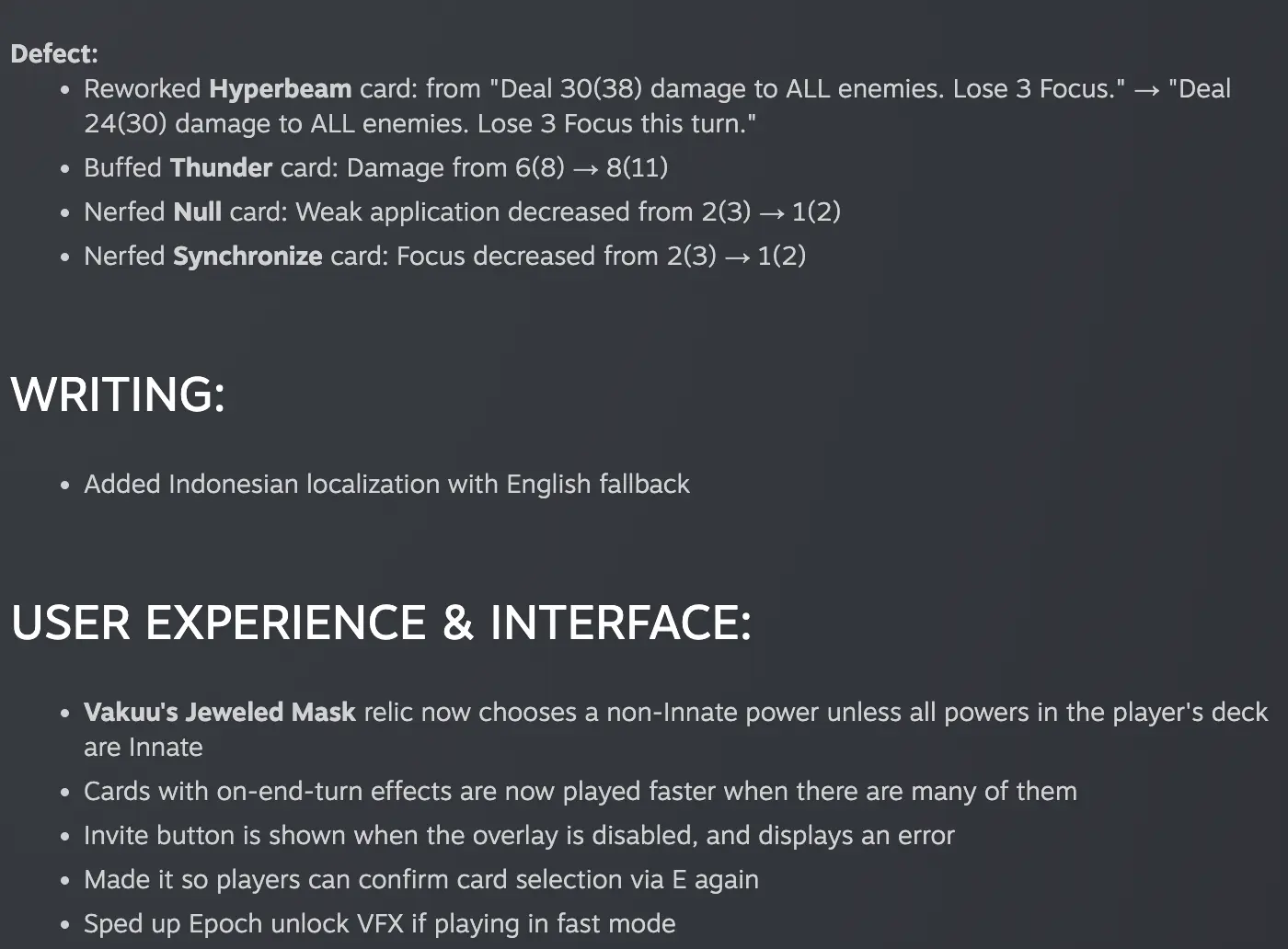
Hyperbeam gives up some raw damage, but temporary Focus loss is a much easier cost to absorb than permanently weakening the orb engine for the rest of combat.
This makes a large difference in a real Defect deck.
Before, there were turns where Hyperbeam solved the immediate problem but damaged the plan I expected to use for every turn afterward. If Frost or Lightning was supposed to carry the fight, permanent Focus loss created a real conflict.
Now I only need to care about what losing 3 Focus does this turn.
That is still not free. If I need Frost Block or orb damage before ending the turn, the temporary loss matters.
But on the next turn, my orb engine is still there.
That makes 24 damage, or 30 upgraded, much easier for me to accept as burst damage.
The other Defect changes mostly move thresholds rather than changing entire roles:
- Thunder:
6(8) → 8(11)damage - Null:
2(3) → 1(2)Weak - Synchronize:
2(3) → 1(2)Focus
Null is the one that changes my upgrade planning most clearly.
At base, one turn of Weak is much easier to outgrow than two. If I actually need Null to carry defensive value across multiple enemy turns, the upgrade now matters more.
Synchronize moves in a similar direction. The base version gives less Focus, so I care more about whether I have time to upgrade it before relying on the card as an engine piece.
Thunder simply becomes better early damage. I still would not turn one Thunder into an excuse to stuff the deck with Lightning cards that do not solve anything else.
Mirage Now Has a Real One-Use Versus Repeat-Use Decision
The Silent changes are less dramatic than the two full reworks, but Mirage changes in a way that affects how I use an upgrade.
Mirage now Exhausts at base.
The upgrade removes Exhaust instead of lowering the cost from 1 to 0.
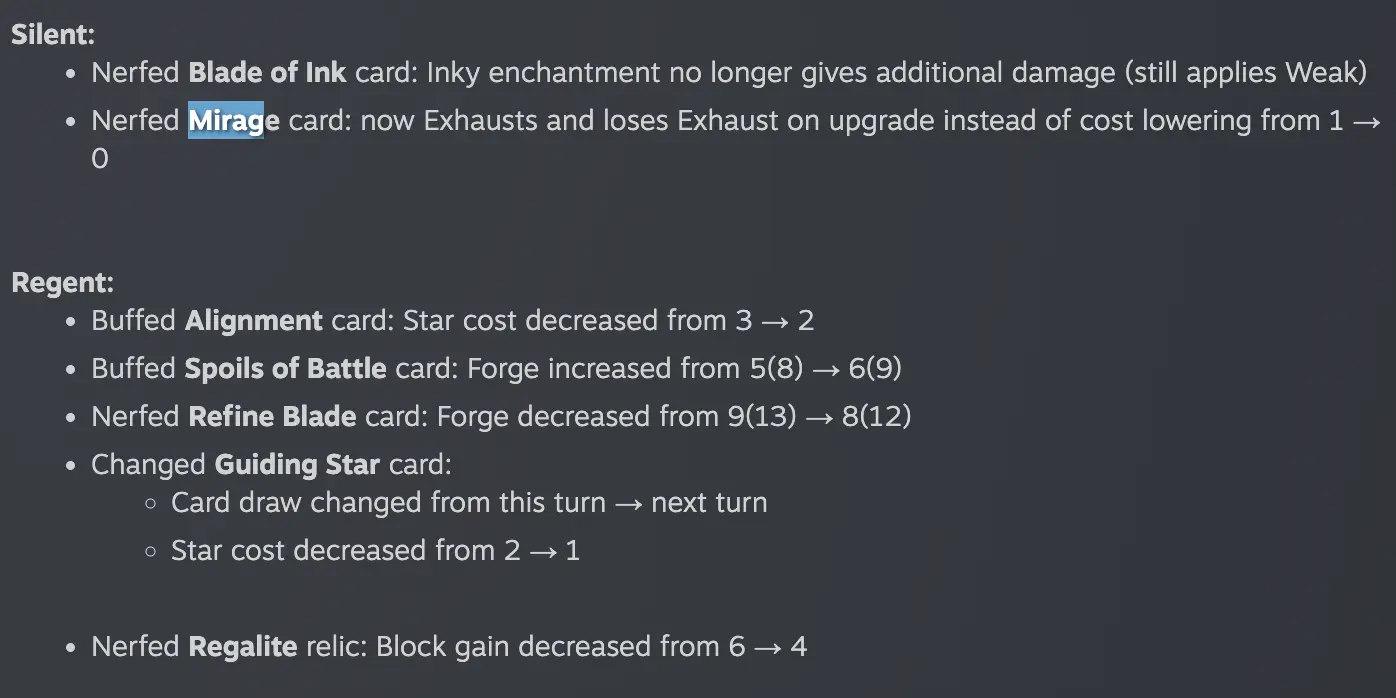
Mirage now asks whether I need one strong use or a repeatable effect. Its upgrade changes longevity instead of simply making the turn cheaper.
That gives me a much cleaner decision.
If one Mirage use already solves the fight or does the job I wanted, Exhaust is not automatically a problem.
If the deck expects to cycle back to Mirage several times, removing Exhaust becomes the important breakpoint.
That is more meaningful than simply saying the card was nerfed.
Blade of Ink also loses the extra damage from Inky while keeping Weak. I still see useful defensive value there. The patch cuts free damage without removing the part of the card that helps reduce incoming pressure.
A nerf does not automatically turn a strong card into a bad card.
The Regent Changes Matter More at Thresholds Than at the Archetype Level
Regent receives several changes, but I would not rebuild my whole draft plan around them.
Alignment drops from 3 Stars to 2.
That is better, but two Stars can still be expensive when the deck already has several reasons to spend them. The lower requirement gets me to reconsider the card; it does not magically create spare Stars.
Spoils of Battle moves from 5(8) Forge to 6(9).
One extra Forge is most noticeable early, while the sword is still small enough for a single point to move an actual breakpoint. In Forge-heavy decks, I already have reasons to tolerate the card for its other utility, so this makes early copies easier to accept.
Refine Blade moves the other way:
9(13) Forge → 8(12).
It is still performing the same job. The nerf simply removes a little efficiency from a common card that could push the weapon very quickly.
Guiding Star is more interesting because two things changed at once:
- Star cost: 2 → 1
- card draw: this turn → next turn
I now treat it more like delayed setup. The cheaper Star requirement helps, but it no longer repairs the current hand immediately.
Regalite also falls from 6 Block to 4.
That is a real nerf, but losing two Block does not tell me the whole value of a relic whose surrounding engine may still trigger repeatedly.
Necrobinder Buffs Still Need the Right Deck
Necrobinder gets two simple-looking buffs:
- Shroud:
2(3) → 3(4)Block - Time’s Up: no longer Exhausts
Shroud is the easier one to understand.
An extra point of Block becomes valuable when the deck already plays enough cards or Powers to trigger the effect repeatedly. In those decks, a small numerical change gets multiplied across the turn.
Without that engine, the buff is much less impressive.
That is why I do not use “this card was buffed” as the reason to start building around Shroud. I first want the cards that make repeated Shroud triggers worth something.
Time’s Up has the opposite problem.
Removing Exhaust makes the card repeatable, but repeatability only matters if I wanted to play the effect again. If Doom is not central to how the deck wins, getting another use does not suddenly solve that mismatch.
The patch improves the card mechanically without guaranteeing that it belongs in more decks.
High Ascension Has New Lethal Breakpoints
The enemy changes are where v0.111.0 can quietly punish an old habit.
Seven tracked monsters changed, with several buffs specifically affecting A8 or A9.
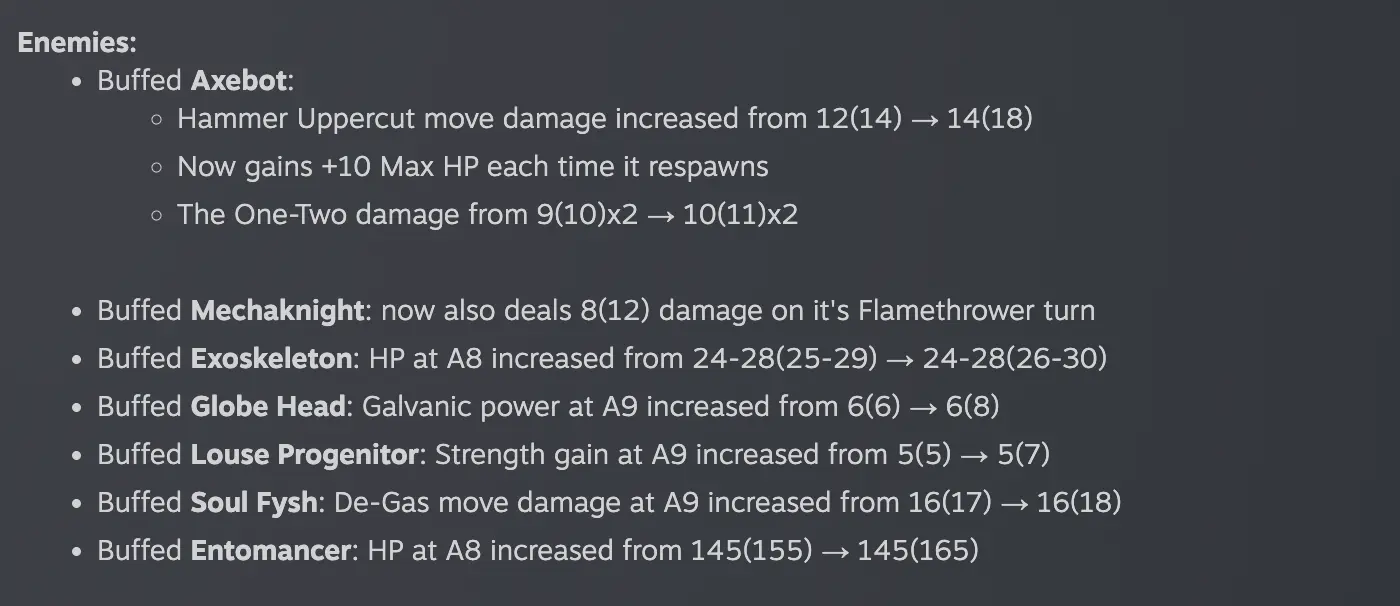
At high Ascension, a small HP or damage increase is enough to turn an exact lethal into one more enemy turn. These are the changes I recalculate instead of assuming my old lines still work.
Exoskeleton is a good example.
At A8 its HP changes from:
24–28(25–29) → 24–28(26–30)
The increase looks tiny.
In play, one extra HP is enough to break a sequence that previously killed a common roll exactly. If the enemy survives with 1 HP, the real cost is not one missing damage — it is the entire extra enemy action that follows.
Soul Fysh is another enemy I respect more after this patch.
Its A9 De-Gas damage changes from 16(17) to 16(18). Because that attack interacts with an already dangerous combat state, a small printed increase can translate into a much more painful real hit.
Louse Progenitor increases its A9 Strength gain from 5(5) to 5(7).
Globe Head increases A9 Galvanic from 6(6) to 6(8).
Entomancer moves from 145(155) to 145(165) HP at A8.
Those are exactly the kinds of changes I want to know before entering higher Ascensions, because old damage checks become unreliable even if the rest of my deck is unchanged.
Axebot receives a broader set of buffs:
- Hammer Uppercut: 12(14) → 14(18)
- One-Two: 9(10) × 2 → 10(11) × 2
- each respawn now adds 10 Max HP
That makes a slow Axebot fight more expensive.
Weak and Frail already punish decks that let the combat drag. More damage plus a tougher respawn increases the price of every extra cycle.
Mecha Knight also now deals 8(12) damage on its Flamethrower turn, so a turn that previously felt closer to setup or breathing room now has real incoming damage attached to it.
My A8/A9 check: before trusting an old line, I recalculate whether my normal attacks still cross the same lethal threshold. Exoskeleton HP, Axebot durability, and Soul Fysh damage are small changes on a patch sheet but large changes when they create one extra enemy turn.
Beautiful Bracelet Loses the Part I Valued Most: Control
The Ancient changes are a good example of why I care about more than the printed number.
Brightest Flame now costs 2 Max HP instead of 1.
That does not erase its upside, but doubling a repeatable Max HP cost makes me much less casual about using it several times before difficult fights are finished.
The larger practical nerf is Beautiful Bracelet.
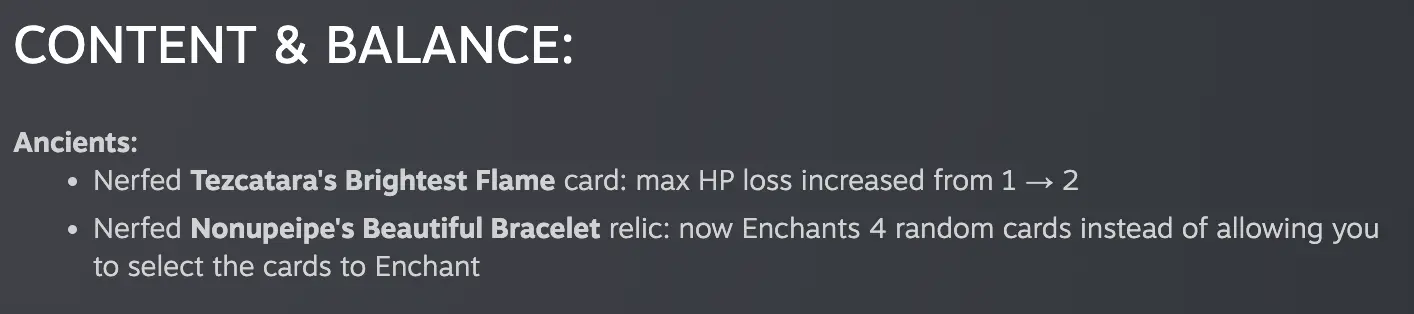
Beautiful Bracelet still Enchants four cards, but those cards are random. Losing target selection removes much of the control that made the relic easy to exploit.
Beautiful Bracelet still Enchants four cards.
The difference is that I no longer select those four cards.
That is a much larger gameplay nerf than the unchanged number suggests.
Previously, I could push the effect into cards where the Enchant was especially efficient. Zero-cost cards were obvious targets because I knew exactly where the value was going.
Random targeting changes the relic into a variance problem.
If most of my deck is an acceptable target, I can still be happy.
If only a few cards really benefit, I now have to price in the chance that the Enchants land somewhere mediocre.
The count stayed at four.
The reliability did not.
Rend Is Easier to Use, but That Does Not Mean I Buy It Automatically
Rend drops from 2 Energy to 1, while its damage falls from 15(18) to 10(12).
I prefer that shape in actual turns.
One Energy is much easier to fit alongside the debuffs that improve Rend’s payoff. The lower base damage matters less when the deck already applies enough Weak, Vulnerable, Doom, Poison, or other debuffs to scale the hit.
Where I still make a distinction is generation versus purchase.
If Rend appears from random generation, one Energy makes it far easier to use without destroying the rest of the turn.
If I am in a shop, a Rare Colorless card is competing against removals, relics, potions, and cards that may solve a more urgent problem.
So the patch makes Rend more usable without making “buy Rend” a universal rule.
The other Colorless changes are mostly availability changes:
- Salvo: Rare → Uncommon
- Splash: Uncommon → Rare
Those shifts change how often I expect to see the cards more than they change the way I play them once they are already in my deck.
Most of the Remaining Patch Makes the Game Smoother, Not Strategically Different
v0.111.0 also includes changes I notice without preparing a new draft rule for them.
The patch adds Indonesian localization, new low-HP idle animations for every playable character, several new card portraits, faster resolution for large groups of end-of-turn effects, and a collection of UI, multiplayer, save, controller, and performance fixes.
One system change does affect a gameplay result directly:
Vakuu’s Jeweled Mask now prefers a non-Innate Power unless every Power in the deck is Innate.
That removes an outcome I normally did not want and makes the relic behave more predictably.
The Dexterity Potion is also green again.
Nice to see, but not something I rebuild a deck around.
For an actual Beta run, my preparation order is much shorter than the full changelog:
- relearn Expect a Fight;
- relearn Hyperbeam;
- reconsider upgrades for Mirage, Null, and Synchronize;
- recalculate A8/A9 lethal thresholds;
- stop treating Beautiful Bracelet as targeted Enchant value.
Everything else can reveal itself naturally as I play.
What I Would Change Before My Next v0.111.0 Run
I would not rebuild every tier list because of this patch.
I would change a handful of habits.
With Ironclad, Expect a Fight is now a Strength-and-Energy question rather than an Energy-generation question.
With Defect, Hyperbeam enters far more reward discussions because using it no longer permanently damages the orb plan. Null and Synchronize also deserve more attention at the upgrade screen.
With Silent, Mirage becomes a clearer choice between one strong use and repeatable value.
With Regent, I watch Forge and Star thresholds instead of treating small numerical changes as new archetypes.
With Necrobinder, I let the existing engine justify Shroud rather than letting the Shroud buff justify building the engine.
And at A8/A9, I stop assuming an enemy dies to the same sequence it did in the previous Beta.
That is the real effect of v0.111.0: not a completely new game, but enough changed thresholds that several familiar decisions deserve to be checked again.
For the full developer changelog, see the official v0.111.0 patch notes on Steam.