Definition (use this mid-run)
You have a Vulnerable Engine if you can answer “yes” to two questions:
- •Window creation: can you apply Vulnerable on demand (often enough)?
- •Window conversion: when Vulnerable is up, do you consistently draw attacks worth multiplying?
Only creation = you’re debuffing with no teeth. Only conversion = you’re gambling on draw order. Engines win because they reduce the amount of “hoping” you do.
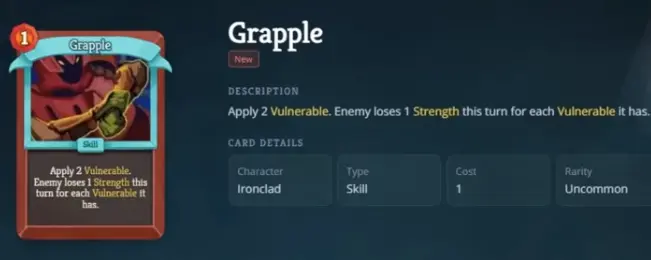
Build it in 3 pieces
A real engine isn’t “lots of Vulnerable.” It’s a small package that reliably produces the right turn. Think in parts, not cards:
Creates the window. You don’t need many copies — you need access on the turns that matter.
Damage that becomes unfair inside the window (multi-hit, burst lines, efficient attacks).
Draw/retention/recursion so applier + converter meet on the same turn.
Keep the engine small. The moment your deck becomes setup-heavy, you stop converting windows and start dying to bad hands.
Quick decision table
Use this when you’re staring at a draft reward and you have 10 seconds.
Draft checklist (engine-safe)
When you consider an “engine piece,” check for these traps. If you trigger 2+, skip it unless you’re already stable.
- •Solo-dead: does nothing unless paired with another specific card.
- •Timing-dead: only works on the one “perfect” turn you rarely draw.
- •Hand-tax: clogs hands or forces you to hold pieces while taking hits.
- •Defense debt: you must spend defense to assemble, and you die after you spike.
If your engine pieces are not also helping you survive, keep them to a minimum. Let the engine multiply your base — don’t replace your base with setup.
Heuristics (fast rules)
These are intentionally blunt. Break them only if you can say the reason out loud.
- •One window beats three “good cards.” Multipliers scale everything you already have.
- •Access is a win condition. If you can’t line up turns, your plan is luck-based.
- •Small package, high impact. Engines should feel like “2–5 cards that change the run,” not “half the deck.”
- •Don’t chase perfect math in EA. Chase repeatability: turns you can reproduce.
Failure modes (how engines still lose)
Engines feel powerful, so they fail in predictable ways. If you recognize one, adjust immediately.
You apply Vulnerable on a turn with no attacks, or draw attacks when the window is down. Fix by adding access (draw/retention) or trimming clogs.
You spend defense to assemble or to spike, then the enemy’s next spike ends the run. Fix by drafting a second defensive line you can play after the big turn.
Too many pieces that do nothing alone. The engine becomes the deck. Fix by shrinking the package and letting it amplify your base.
If you’re low HP or out of resources, the priority order changes: survive → stabilize → then engine. Drafting a clean engine is meaningless if you can’t reach the next campfire.

Where to use this
Link this page from any boss/elite guide where the fight is decided by burst windows, debuffs, or fast tempo flips. Over time, that internal link graph turns SpireGenius into a mechanic atlas — not a wiki mirror.