The mental model
Ironclad doesn’t win Early Access runs by “having a strong deck.” He wins by repeatedly answering one question: can I survive the next enemy tempo spike without spending my future? Your draft choices should therefore do one of three jobs:
- •Stabilize: stop bleeding HP when the enemy has the initiative.
- •Spike: produce a turn where you decisively flip the fight (damage window, debuff window, resource window).
- •Scale: make your “good turns” become inevitable (repeatable, not once-per-run).
If a card/relic does none of the above in your current run state, it’s noise—even if the community calls it “S-tier.”
What we’re actually scaling
In practice, Ironclad scaling can be reduced to two levers you can feel in real time:
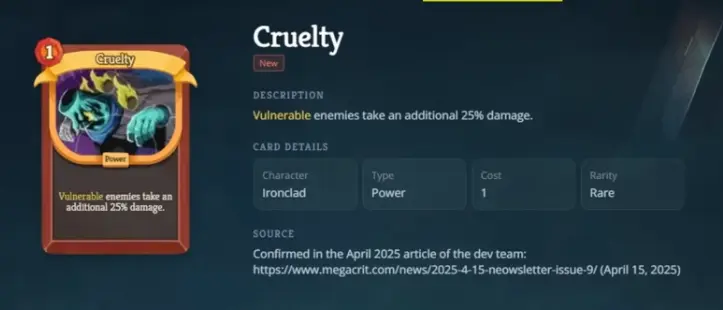
Not “DPS.” You want damage that lands during your windows: when the enemy is vulnerable, when you have multi-hit, or when you can safely commit.
If you spend everything to survive one scary turn, you didn’t stabilize—you delayed death. Stabilization means your defense (or mitigation) can show up again.
The shortest path to combine both levers is usually a debuff-driven plan. That’s why the Vulnerable Engine is a useful “default direction” until the meta stabilizes.
Draft checklist (decision engine)
When a card shows up, run this checklist in your head. If you can’t answer “yes” to at least one, you’re likely buying a future problem.
- 1 Does this reduce incoming damage next fight? (block, weaken, stun-like control, positioning tools)
- 2 Does this create a spike window? (burst turn, debuff turn, guaranteed setup turn)
- 3 Does it repeat? (draw, retention, recursion, low-cost loop pieces, “shows up often”)
- 4 What does it cost me? (energy, hand space, clogging, “dead vs bosses,” timing risk)
If you are not already stable, prioritize stabilize over scale. Scaling is only “real” when you can survive long enough to see it twice.
Heuristics (non-water rules)
These are intentionally phrased as rules you can apply instantly. Break them only when you know why.
- •Act 1: win by consistency. Your first goal is a deck that can survive a bad draw.
- •Energy is not power. Energy is permission. Spend it on the turns that matter (debuff windows / lethal windows).
- •Don’t draft “future synergy” into an unstable present. One “dead” card often costs more HP than it gains later.
- •Debuffs scale your whole deck. A single Vulnerable/Weak effect can upgrade every attack/block you already own.
- •If you rely on one perfect turn, you don’t have a plan. Look for repeatability: draw, redundancy, or a second line.
Countercases (when this direction fails)
If you want this page to feel honest (and therefore trustworthy), you must surface failure modes. Here are the most common ways a debuff-driven Ironclad plan can still lose.
Applying Vulnerable is worthless if you don’t draw attacks on that window. Fix with: more draw, fewer clogs, or a smaller “must-have” package.
Some fights punish over-commit: you spend your mitigation to land the big turn, then the enemy’s next pattern ends the run. Fix with: a “second defense line” you can still play after the spike.
Engines are fragile when they are the majority of your deck. The rule: keep your engine small, and let it amplify your existing base.
If you’re in a desperation state, switch your priority order: survive → stabilize → then scale. “Perfect direction” doesn’t matter if you can’t reach the next campfire.